
Understanding Energy Systems, VO₂max, and the Science Behind Training at Black Flag Strength & Conditioning
The difference between simply working hard and training with purpose is fundamental to a well-structured strength and conditioning program. At Black Flag Strength & Conditioning, we invest considerable time and thought into our programming because intelligent training can be the difference between sustained progress and eventual burnout.
Walk into almost any gym, and you’ll see people pushing themselves. Heart rates climb, muscles burn, and exhaustion is often worn like a badge of honor. Somewhere along the way, we’ve adopted the idea that the effectiveness of a workout should be measured by how tired we feel when it’s over.
But exhaustion isn’t necessarily an indicator of progress. The more important question is whether a training session produces the physiological adaptations we’re seeking.
Our objective at Black Flag is to develop stronger, more powerful, better-conditioned individuals capable of performing across a broad spectrum of physical demands. Accomplishing that requires an understanding of how the body produces energy, how the nervous and hormonal systems respond to exercise, and why the relationship between work and recovery is as important as the work itself.
To appreciate the science behind our programming, we need to look beyond the movements on the whiteboard and understand what’s happening within the body when we train.
The Energy Behind Every Movement
Every physical action, from a maximal deadlift to a leisurely walk, depends on our body’s ability to produce and regenerate energy.
At the center of this process is adenosine triphosphate (ATP), the immediate energy currency that powers muscular contraction and countless cellular processes.
Because our muscles store relatively little ATP, it must be continually regenerated to sustain movement. This is where bioenergetics, the study of how living organisms transform and utilize energy, becomes particularly relevant.
The body relies on three interconnected energy systems: the phosphagen, glycolytic, and oxidative systems.
The phosphagen system supplies rapid energy for explosive efforts such as heavy lifting, jumping, and short sprints. The glycolytic system becomes increasingly important during demanding, high-intensity exercise requiring rapid ATP production. Meanwhile, the oxidative system supports sustained activity and contributes significantly to recovery and repeated performance.
Importantly, these systems never operate independently. All three contribute simultaneously, with their relative involvement changing according to exercise intensity, duration, training status, and recovery.
Understanding this relationship allows us to move beyond simply prescribing difficult workouts and begin developing specific physiological capacities.
Power and Capacity: Two Sides of Performance
An important distinction in exercise physiology is the difference between power and capacity.
Power refers to the rate at which an energy system can supply ATP, while capacity describes how much energy it can contribute over a particular demand.
Consider an explosive athlete capable of producing tremendous force during a heavy lift or short sprint but whose performance declines rapidly when those efforts are repeated.
Now consider an athlete who may lack the same explosive capabilities but can sustain a moderate workload for an extended period and recover efficiently between efforts.
Both possess fitness, but their physiological strengths are different.
At Black Flag, we’re interested in developing both qualities. We want our members to generate and absorb high levels of force, produce power efficiently, sustain challenging workloads, and recover effectively.
That requires exposing the body to different physiological demands rather than repeatedly training at one intensity.
Developing the Full Spectrum of Human Performance
Our programming reflects the understanding that different physical demands require different physiological responses.
During strength and power sessions, we emphasize high-force production, explosive movement, and neuromuscular efficiency. Heavy compound lifts, Olympic lifting variations, jumps, throws, and brief maximal efforts challenge our ability to recruit motor units, coordinate muscular contractions, and generate force rapidly.
These sessions require appropriate recovery to preserve movement quality and maintain high levels of output.
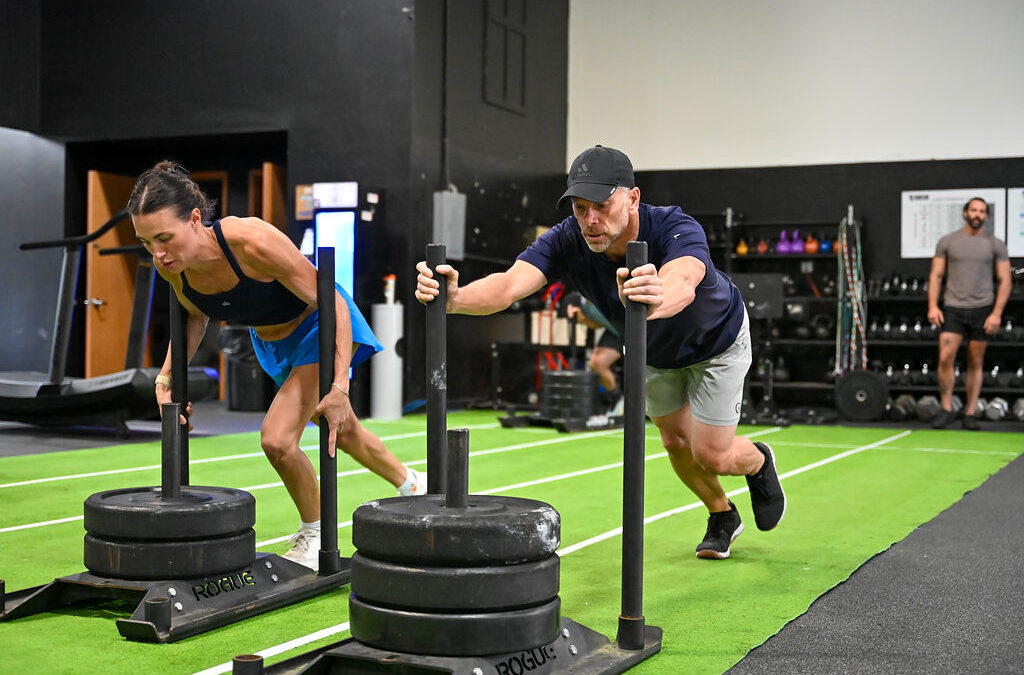
During higher-intensity conditioning, the metabolic demands change. Repeated efforts on a rower, challenging sled pushes, loaded carries, and functional circuits place substantial demands on glycolytic and oxidative metabolism. Here, we’re developing the ability to sustain challenging workloads and repeat efforts while managing fatigue.
Then there’s aerobic development, an essential but sometimes under-appreciated component of strength and conditioning.
Our oxidative system supports sustained activity, contributes to recovery between demanding efforts, and helps maintain performance throughout training. It’s also central to cardiovascular health and long-term physical capability.
These qualities complement one another. Greater strength can reduce the relative effort required for a given task. Improved aerobic fitness can support recovery between high-intensity bouts, while muscular endurance helps preserve movement quality as fatigue accumulates.
The objective isn’t to become exceptional at one narrow expression of fitness. It’s to develop a body capable of meeting a wide variety of physical challenges.
VO₂max: Understanding Our Aerobic Ceiling
One of the most valuable measures of cardiorespiratory fitness is VO₂max.
VO₂max represents the maximum rate at which the body can take in, transport, and utilize oxygen during progressively demanding exercise. It provides an indication of the upper limit of aerobic energy production.
But VO₂max is much more than a performance metric for endurance athletes.
It reflects the integrated function of the heart, lungs, circulation, and skeletal muscles. Improving aerobic fitness can stimulate adaptations that enhance oxygen delivery and utilization, including increased cardiac output, greater capillary development, and improved mitochondrial function.
For endurance athletes, these adaptations may translate into faster sustainable paces. For BFSC members, they can contribute to more consistent conditioning performance, improved recovery, and a greater ability to tolerate repeated physical demands.
Perhaps most importantly, higher cardiorespiratory fitness is strongly associated with reduced cardiovascular and all-cause mortality risk.
Developing aerobic capacity isn’t simply about improving conditioning performance. It’s an investment in long-term health.
VO₂max, however, represents only part of aerobic performance. Movement economy, sustainable exercise intensity, and the ability to maintain a high percentage of maximal oxygen consumption also matter.
Effective aerobic development therefore requires more than simply elevating heart rate. It involves carefully selected intensities, durations, and recovery periods that challenge different aspects of the aerobic system.
Mitochondria: The Cellular Foundation of Endurance
Within our muscle cells are mitochondria, structures responsible for much of the ATP produced through aerobic metabolism.
Through interconnected processes, including the Krebs cycle and electron transport chain, mitochondria utilize energy derived from carbohydrates and fats to support ATP production.
Regular exercise can stimulate mitochondrial biogenesis, increasing mitochondrial content while improving the function of existing mitochondria. These adaptations support exercise tolerance, metabolic flexibility, and sustained physical performance.
Interestingly, different training intensities can stimulate these adaptations through overlapping but distinct physiological mechanisms.
Lower-intensity aerobic exercise provides a sustainable stimulus with relatively modest mechanical stress. Higher-intensity exercise creates greater demands on oxygen delivery, utilization, and cellular energy regulation.
Both approaches contribute to aerobic development.
At Black Flag, we recognize that these adaptations aren’t dependent on a single exercise or training format. Rowing, cycling, running, SkiErg work, and appropriately structured conditioning sessions can all provide meaningful stimuli.
The key is matching intensity, duration, and recovery to the adaptation we’re seeking.
The Nervous System: More Than an Energy Problem
Energy production is fundamental to performance, but it’s only part of the equation.
Our ability to express strength, power, and coordinated movement also depends heavily on the nervous system.
The central nervous system organizes movement, while the peripheral nervous system communicates with the muscles responsible for producing force. Through training, we can improve motor unit recruitment, neuromuscular coordination, and the efficiency with which force is generated and controlled.
These adaptations help explain why metabolic and neuromuscular fatigue aren’t interchangeable.
A conditioning session may create substantial cardiovascular stress without imposing the same high-force demands as heavy strength training. Conversely, a demanding strength session can significantly challenge neuromuscular performance without producing a sustained aerobic response.
Hormonal responses also influence energy availability, tissue remodeling, and recovery, although no single acute hormonal response determines the effectiveness of a workout.
Adaptation results from the interaction of mechanical loading, metabolic demand, neural activity, nutrition, and recovery over time.
Recognizing these differences allows us to organize training more intelligently.
Why Rest Is Part of the Prescription
One of the most misunderstood components of effective training is recovery between efforts.
In many fitness environments, rest is something to minimize. Shorter recovery periods are assumed to create harder workouts, and harder workouts are assumed to produce better results.
Physiology tells us otherwise.
Recovery influences energy availability, metabolic stress, neuromuscular performance, and the quality of subsequent efforts.
During explosive training, adequate rest allows phosphocreatine stores to replenish and helps preserve power output. During repeated high-intensity conditioning, work-to-rest relationships influence fatigue accumulation and the ability to sustain performance. During aerobic training, appropriate recovery allows us to accumulate meaningful work while maintaining the intended cardiovascular stimulus.
This is why our workouts at Black Flag incorporate deliberately planned work-to-rest ratios.
Some sessions emphasize maximal output followed by sufficient recovery. Others challenge sustained movement at a controlled intensity. Still others develop the ability to repeat demanding efforts under accumulating fatigue.
Each creates a different physiological stimulus, and each has a place within a comprehensive training program.
Rest isn’t an interruption of the workout. It’s part of the prescription.
Why We Don’t Chase Exhaustion Every Day
It’s relatively easy to design a workout that leaves someone exhausted.
It’s considerably more difficult to build a program that develops multiple physiological capacities, manages fatigue, and produces meaningful adaptations over months and years.
At BFSC, we consider the cumulative demands of training.
Higher-force strength sessions create significant neuromuscular and musculoskeletal stress. Conditioning sessions challenge energy production through different intensities and durations. Other sessions emphasize aerobic development and movement quality while limiting unnecessary mechanical stress.
We also consider eccentric loading, total volume, exercise complexity, and how one session influences the next.
A heavy lower-body strength session creates different recovery demands than a predominantly cyclical aerobic workout. Both can be challenging, but their physiological costs differ.
This approach reflects the principles of concurrent training: developing multiple physical qualities within a coordinated program.
The challenge isn’t simply deciding which qualities to train. It’s organizing them so they complement rather than unnecessarily interfere with one another.
Sometimes intelligent programming means pushing harder. Other times, it means recognizing when additional intensity offers little benefit relative to the fatigue it creates.
Fitness Is More Than a Single Number
Wearable technology, heart-rate monitors, calorie expenditure, and performance metrics have made fitness increasingly measurable.
These tools provide valuable information, but none tells the complete story.
A higher heart rate doesn’t automatically indicate a better workout. Greater calorie expenditure doesn’t necessarily mean a more productive session. And exhaustion is not synonymous with adaptation.
Consider someone who produces greater power across repeated efforts, sustains a higher workload at the same heart rate, or improves maximal strength while maintaining aerobic fitness.
These are meaningful expressions of progress, even when they don’t result in the most exhausting workout of the week.
At Black Flag, every prescribed pace, loading strategy, and recovery interval serves a purpose.
We’re not simply arranging exercises to fill an hour. We’re applying specific physiological stimuli designed to produce lasting adaptations.
Building Capacity for Life
The value of developing multiple physiological capacities extends well beyond the gym.
Life doesn’t operate within a single intensity domain.
Sometimes we need strength to move something heavy. Sometimes we need power to react quickly or absorb force safely. Other times we need endurance to sustain activity or the capacity to recover from repeated physical demands.
As we age, preserving these qualities becomes increasingly important.
Strength supports muscle mass and physical independence. Power contributes to rapid force production and our ability to respond to unexpected challenges. Aerobic fitness supports cardiovascular health, endurance, and overall physical resilience.
Together, these qualities influence not only how we perform in the gym but how capable we remain outside of it.
That’s the larger purpose behind our approach at Black Flag.
Fitness isn’t defined by a single workout, performance metric, or level of exhaustion. It’s the cumulative result of intelligent training, appropriate recovery, and consistent effort over time.
The Black Flag Philosophy: Train With Intention
There’s both an art and a science to effective strength and conditioning.
The science helps us understand how the body responds to different training demands. The art lies in applying those principles to individuals with different abilities, experiences, goals, and recovery capacities.
At Black Flag Strength & Conditioning, our responsibility as coaches is to bring those elements together.
Our members deserve more than a collection of challenging exercises. They deserve a training program with purpose.
One that develops strength without neglecting endurance. Builds power while respecting movement quality. Challenges cardiovascular fitness without disregarding recovery. And recognizes that sustainable progress requires more than simply working harder every day.
Every loading prescription, conditioning interval, and recovery period should contribute to a larger objective.
Because the real measure of effective training isn’t how exhausted someone feels when the session ends. It’s how the body adapts, how performance improves, and how those improvements contribute to a healthier, more capable individual.
Our goal has never been to make people better at being tired.
Our goal is to make people better at being human.
Stronger. More powerful. Better conditioned. More capable.
Not just for the next workout, but for everything life asks of us.
That’s the science. That’s the philosophy. That’s Black Flag Strength & Conditioning
Yours in Fitness,
CSCS | CFL3 | Fitness Specialist | Biomechanics Specialist | USAWL1
“Take care of your body. It’s the only place you have to live.”
Owner/Coach – Black Flag Strength & Conditioning