
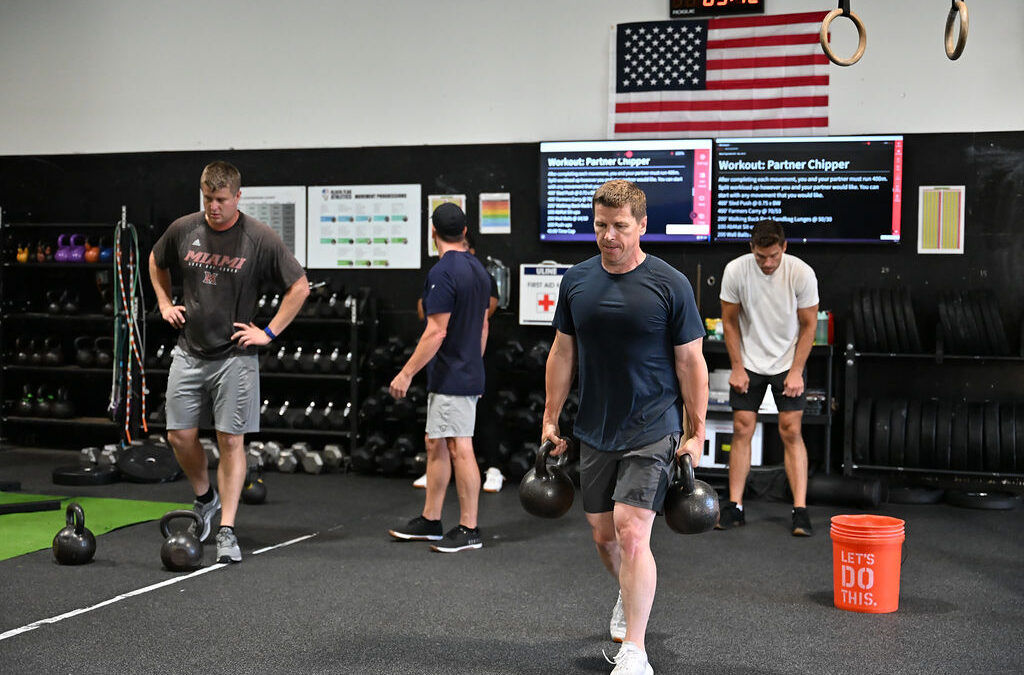
The Minimum Effective Dose: Why Smarter Training Wins
How the right amount of training—not the most training—can build strength, muscle and fitness for the long haul.
Somewhere along the way, we started confusing exhaustion with effectiveness. Good Strength & Conditioning isn’t about how tired you can make someone. It’s about applying the right dose of training, recovering from it, and coming back better.
Walk into almost any gym and you’ll see our obsession with making training harder.
More exercises. More sets. Less rest. More conditioning. More sweat.
We’ve created a culture where finishing a workout lying on the floor feels like proof that something productive happened.
But fatigue and progress are not the same thing.
Training should be hard. It should challenge us. But the goal isn’t to see how much work we can survive.
The goal is adaptation.
Training Is a Dose
Think about training like a dose.
Too little stimulus and very little happens. Apply the appropriate amount and the body has a reason to adapt. Continue piling on work beyond what’s necessary and eventually the recovery cost begins outweighing the additional benefit.
This is the idea behind the minimum effective dose.
It doesn’t mean minimum effort. It means finding the appropriate amount of quality work required to create the adaptation we’re looking for.
Research consistently shows that strength and muscle can be developed through a variety of training volumes and frequencies. More volume can produce additional benefits, particularly for muscle growth, but those benefits eventually begin to diminish.
That’s why the question shouldn’t always be:
“Can we do another set?”
Sometimes it should be:
“Will another set actually make us better?”
Recovery Is Part of the Program
We love talking about workouts. We don’t talk nearly enough about what happens between them.
The workout creates the stimulus.
Recovery is when we adapt to it.
Following resistance training, muscle protein synthesis can remain elevated for roughly 24–48 hours, although this varies based on training status, workload, nutrition and the individual.
That doesn’t mean you need exactly 48 hours between every workout. Experienced lifters can train frequently when volume and intensity are distributed intelligently.
But it does mean recovery matters.
Sleep matters. Nutrition matters. Stress matters. And programming matters.
The harder the stimulus, the larger the recovery bill.
Sometimes the smartest thing you can do for tomorrow’s training is not add more training today.
Stop Chasing Fatigue
You don’t need to PR every week.
You don’t need to take every set to failure.
And you don’t need to completely overhaul your program every month.
Progress is usually much less exciting.
Five more pounds. Another quality rep. Better technique. More range of motion. A faster bar. Better recovery.
Repeat those improvements consistently for months and years and something significant happens.
Consistency compounds.
The same principle applies to training to failure. Getting close to failure can be extremely valuable for muscle development, but constantly taking every set to absolute failure creates additional fatigue that has to be recovered from.
Sometimes pushing harder is the answer.
Sometimes stopping with one or two quality repetitions remaining allows you to produce more high-quality training over the course of the week.
We’re not trying to win Tuesday.
We’re trying to continue progressing for years.
Everything Matters. Everything Can’t Be the Priority.
Strength. Muscle. Power. Speed. Conditioning. Mobility. Athleticism.
We want all of them.
But trying to maximize every quality simultaneously often leads to doing too much of everything.
Good programming manages those qualities.
Certain periods may emphasize strength while conditioning is maintained. Other blocks may increase hypertrophy volume. Athletes approaching competition may emphasize speed and power while reducing unnecessary weight-room volume.
That’s the difference between programming and simply putting workouts together.
One asks:
“What can we do today?”
The other asks:
“What are we trying to accomplish, and what do we need to do today to move closer to it?”
Train Hard. Recover. Adapt. Repeat.
After nearly three decades around Strength & Conditioning, I’ve become less impressed by workouts that look difficult on a whiteboard and more interested in programs that continue producing results.
Can we make you stronger without unnecessarily beating up your joints?
Can we build muscle without burying you in volume?
Can we improve conditioning without compromising strength?
Can we make an athlete better while still leaving them capable of practicing and competing?
Most importantly:
Can we keep you training?
Because one brutal workout means very little.
Hundreds of quality workouts accumulated over years can completely change what you’re physically capable of.
At Black Flag, we’re not interested in making training harder simply because we can.
We’re interested in making people better.
Apply the stimulus.
Recover from it.
Adapt.
Then gradually ask the body for more.
The goal isn’t to survive today’s workout.
The goal is to be better prepared for tomorrow.
Yours in Fitness,
CSCS | CFL3 | Fitness Specialist | Biomechanics Specialist | USAWL1
“Take care of your body. It’s the only place you have to live.”
Owner/Coach – Black Flag Strength & Conditioning