
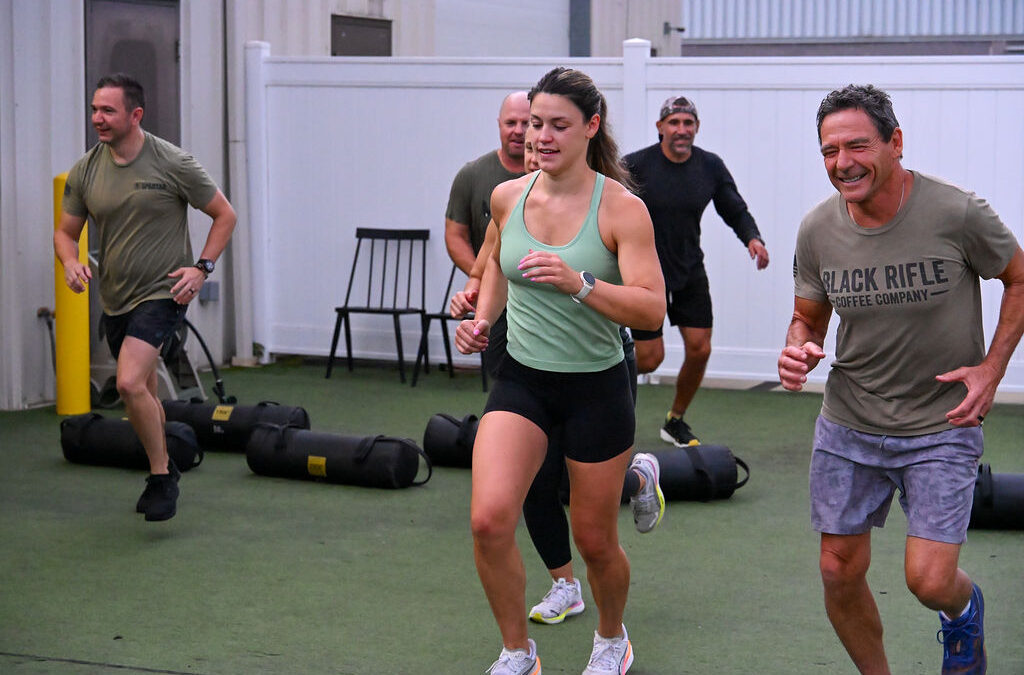
If you’ve ever looked at our training schedule and wondered, “Why are we doing this today?”—there’s a reason.
We don’t build our programming by randomly selecting exercises and hoping everyone is sufficiently sore by the end of the week. Each training session has a purpose, and more importantly, each session fits into a larger plan designed to develop multiple qualities of fitness: strength, muscle, power, speed, athleticism, aerobic capacity, and high-intensity conditioning.
The goal isn’t to become really good at one thing while neglecting everything else. We want to build a more complete athlete—someone who can produce force, produce it quickly, sustain work for long periods, and recover well enough to do it again.
That requires variety, but not random variety.
Building the Foundation:
One of our primary training emphases is whole-body strength and hypertrophy. These sessions use compound movements such as squats, presses, rows, deadlifts, and split squats, combined with accessory work. We frequently organize these exercises into supersets to increase training density while still allowing enough recovery to produce high-quality reps.
The hypertrophy emphasis isn’t simply about chasing a muscle pump. We’re trying to create mechanical tension, accumulate productive volume, and gradually increase the amount of work your body can tolerate and recover from.
That’s why you’ll often see moderate rep ranges, controlled eccentrics, and instructions such as“don’t chase fatigue.”
Being exhausted isn’t the goal.
Adaptation is the goal.
There is a difference.
A good training session should challenge you, but it shouldn’t require you to crawl to your car afterward, wondering if someone can explain to your family what happened.
As we transition toward a greater strength emphasis, the volume decreases, and the loads increase. Movements such as a 5 × 3 bench press or deadlift allow us to spend more time working at higher intensities while maintaining quality technique. This develops the ability to produce high levels of force without accumulating unnecessary fatigue.
In other words, hypertrophy helps us build the hardware, while strength training teaches us how to use that hardware more effectively.
Strength Is Only Part of the Equation:
Being strong is valuable, but strength is only one piece of athletic performance.
That’s where our power and speed work comes into play.
Throughout the programming, you’ll see Olympic-lifting variations, push jerks, power snatches, cleans, kettlebells, landmine movements, jumps, and other explosive exercises. These movements teach the body to produce force rapidly.
The distinction between strength and power is important:
- Strength is how much force you can produce.
- Power is how quickly you can produce it.
A strong athlete who can’t express that strength quickly is missing an important piece of the puzzle.
Our athletic-strength work also emphasizes integrated movement. Instead of always training muscles independently, we’ll combine movements such as band presses with kettlebell rows, banded rows with Z-presses, or other push/pull combinations.
This creates an environment where the upper body, lower body, and trunk have to coordinate with one another.
That’s much closer to how the body actually functions outside of a machine.
Our core training follows the same philosophy. Rather than relying exclusively on traditional abdominal exercises, we’ll use movements such as pull-throughs, chops, carries, and other patterns that challenge the trunk to resist or produce movement.
Your core isn’t just there to help you do 50 sit-ups.
It’s there to help you transfer force, stabilize the body, and keep the rest of the system organized while you move.
Learning to Produce Force in Different Ways:
One of the more intentional parts of our programming is the manipulation of eccentric, isometric, and concentric actions.
During an eccentric emphasis, we might prescribe a three-second descent. This teaches control and increases the amount of time the muscles are under tension.
During an isometric emphasis, we may pause in a difficult position—such as sitting in the bottom of a squat or pausing during a press or pull. This eliminates momentum and forces you to create and maintain tension in positions where you’re typically weakest.
Then we shift toward concentric emphasis, where the goal is to produce force rapidly. This might involve explosive lifts, jumps, or other movements performed with maximal intent.
The progression is simple:
Control → Position → Explode.
Each method develops a different quality, and rotating them allows us to train the same movement patterns without asking the body to solve the same problem every week.
Why We Include Both HIIT and Long, Slow Work:
Our conditioning follows the same principle of developing multiple energy systems.
Some days are short, intense, and uncomfortable.
These HIIT sessions typically fall into a 5–10 minute window and rely heavily on machines and bodyweight movements. The goal is to develop our ability to produce high levels of output and repeat those efforts.
These sessions are intentionally short because intensity has a cost.
We don’t need 45 minutes of high-intensity work to create a meaningful stimulus. In many cases, we can create a strong anaerobic stimulus with a much smaller dose.
Then, on other days, we slow things down considerably with Long Slow Distance (LSD) work.
And no, this isn’t the part where we hand you a tie-dye shirt and play psychedelic rock.
LSD training develops the aerobic system through sustained, lower-intensity work. Running, rowing, cycling, skiing, or similar activities can improve aerobic capacity, cardiovascular efficiency, and our ability to recover between harder efforts.
This is an important part of our programming because a better aerobic system doesn’t just help you run farther.
It helps you recover faster.
That means recovering between sets, between intervals, between workouts, and eventually between training weeks.
The combination of HIIT and aerobic work gives us both ends of the conditioning spectrum rather than trying to make every conditioning session a competition.
Introducing the Westside Influence:
In our second programming block, we’ll incorporate principles influenced by the Westside Barbell conjugate system. The basic concept is to expose the athlete to different methods of developing strength and power throughout the week rather than relying on the same stimulus repeatedly.
This introduces Max Effort (ME) and Dynamic Effort (DE) training.
Max Effort work emphasizes producing high levels of force against heavy resistance. This doesn’t necessarily mean testing a true one-rep max every week. Instead, we’ll rotate movements such as bench press, push press, incline bench, squat, deadlift, sumo deadlift, and front squat to expose the body to different strength demands.
Dynamic Effort work takes the opposite approach.
Instead of asking, “How heavy can we lift?”, we’re asking: “How quickly can we move this?”
This is where Olympic lifting, jumps, bands, and lighter explosive movements become valuable.
The combination of Max Effort and Dynamic Effort training allows us to attack strength from two different directions: Maximum force + maximum velocity.
And surrounding those primary lifts with bodybuilding-style accessory work allows us to continue accumulating muscle-building volume. For example, we might pair an incline press with a pull-up or another rowing movement. This gives us additional hypertrophy work while also creating balance between pushing and pulling musculature.
Why the Week Isn’t Hard Every Day:
Perhaps the most important concept behind the programming is fatigue management.
We don’t want every training day to be maximally demanding.
Instead, we’ll move between different stresses.
A week might include: Hypertrophy → HIIT → Power → Aerobic → Strength → HIIT
Another block might look more like: Max Strength → Dynamic Power → Aerobic → Dynamic Power → HIIT → Max Strength
Notice that we’re not simply repeating the same stimulus six days in a row.
That’s intentional.
Heavy strength work creates one type of fatigue. High-intensity conditioning creates another. Long-duration aerobic work creates another. Explosive training creates another.
By alternating these demands, we can train frequently while giving different systems opportunities to recover.
That’s one of the reasons you’ll occasionally have a workout that feels “easier” than the day before. It isn’t filler. It’s part of the plan.
The Bigger Picture:
Ultimately, our programming is built around a simple idea: We want to make you better at being human.
That means building muscle and strength while maintaining the ability to move, accelerate, jump, carry, run, row, ski, cycle, and perform work for extended periods.
We want you to be strong without being slow.
Powerful without being reckless.
Conditioned without sacrificing strength.
Muscular without losing athleticism.
And capable of training hard without constantly beating yourself into the ground.
That requires patience and consistency.
The goal isn’t to win one workout.
The goal is to string together weeks, months, and years of productive training.
Because the best program isn’t the one that leaves you the sorest.
It’s the one that helps you walk through the door next week, a little stronger, a little faster, a little fitter—and ready to do it again.
Relentless,
Head Coach & Programmer